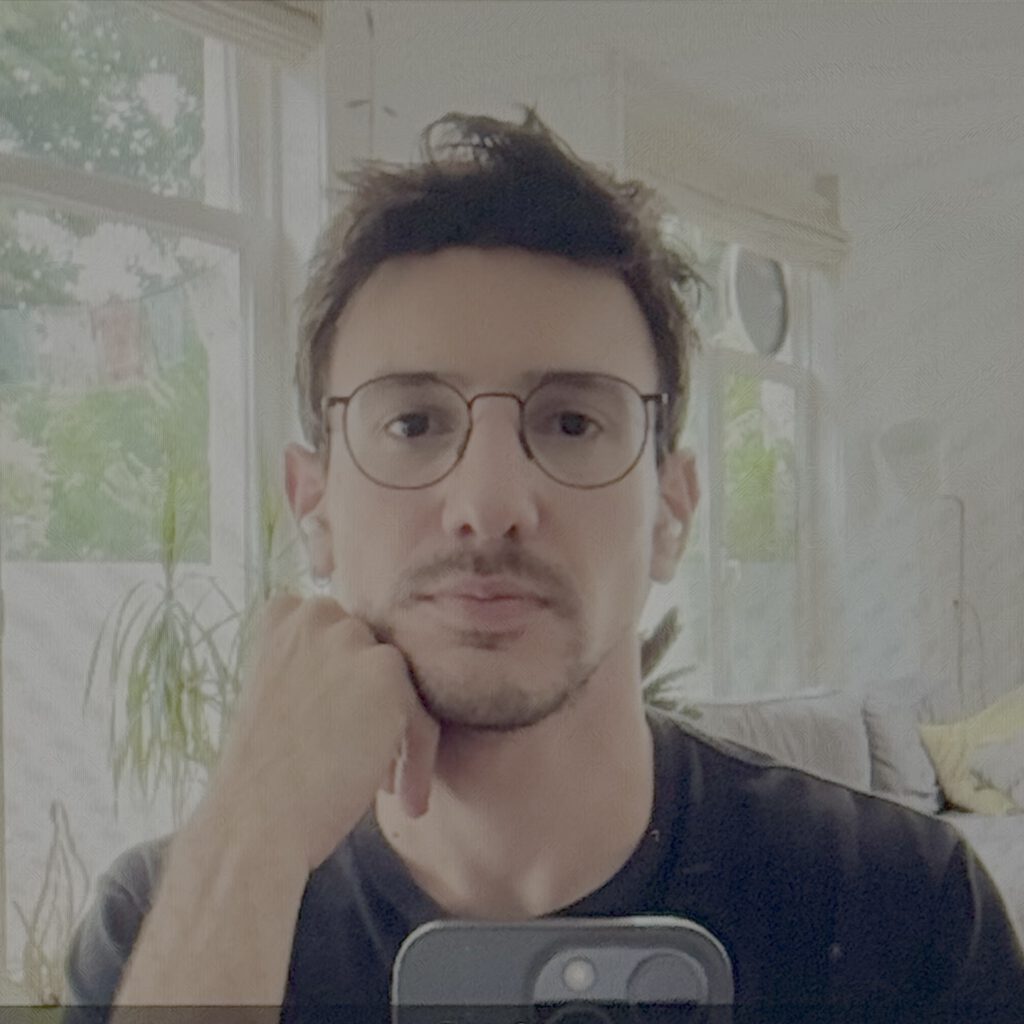
My name is Mauricio, I was born and raised in Buenos Aires (Argentina) and have been living in Amsterdam since 2012. From an early age, I’ve been very passionate about learning, with language acquisition being one of my strengths. From childhood English lessons to watching Italian TV with my grandmother, I’ve always been fascinated by languages and their impact on our minds.
Though I actually began teaching languages in high school, helping classmates with their English and French, I only started calling myself a language teacher much later in life. A few years ago, after unexpectedly finding myself between jobs and questioning everything, I discovered a new purpose in teaching. Since then, I’ve been committed to becoming the best teacher I can be.
Academic formation
Besides being a native speaker, I began studying Spanish language and literature in depth during my final years of high school, to then pursue Philosophy and Art History at the University of Buenos Aires. However, after a year I relocated to the Netherlands and had to shift my focus to learning Dutch before returning to my studies.
I studied Dutch intensively and extensively at Leiden University for about a year before resuming my BA in Philosophy entirely in Dutch, while also exploring subjects like Psychology, Sociology, Anthropology and Gender Studies. These perspectives often enrich my lessons, giving the learning process extra dimension and depth.
Teaching experience
It all started around four years ago when a friend asked me if I could help him with his Spanish. At the time, I had been managing organic food stores for about five years, but had decided I needed a career switch. I wasn’t sure what I wanted to do next, but a few lessons in, I realised not only how much I enjoyed teaching but also how effective and knowledgeable I was as a tutor. I began seeking more students and have since then been teaching Spanish and Dutch at all levels and enjoying it a lot.
In these years, I’ve worked with students from diverse backgrounds and nationalities: some starting from scratch, others with a solid foundation and in need of practice, and some with the goal of deepening their understanding of the languages for academic purposes.
My way of teaching is the way I learned most of the languages I speak: I teach primarily in 1-on-1 or 1-on-2 sessions, ensuring each student gets my full attention. Every lesson is tailored to meet my students’ unique goals, strengths and areas for growth.
One of my strongest suits is my knowledge of multiple languages (Spanish, English, Dutch, Italian, French, Portuguese, and German), which often allows me to compare the language I’m teaching to my students’ native tongues and make learning more relatable. Having learned most of these languages with private tutors, I understand what it’s like to be on the receiving end of a lesson and use this experience to make sessions effective for my students.
Motivation
My mission is to help language learners achieve their goals, whether they’re enthusiastic and eager to master a new language or struggling with discipline and motivation. Everyone learns at their own pace, encounters unique challenges, and brings their own interests and goals to the process. For me, nothing is more motivating than watching a student truly understand the “whats” and “whys” of the language they’re learning.
In the case of Spanish, an incredibly rich and diverse language with hundreds of dialects, variations and forms of slang, my mission is to equip students with the tools they need to master it, make it their own, and use it to broaden their horizons. Many people learning Spanish in Amsterdam are especially interested in these subtleties and I’m always happy to provide the knowledge they seek.
In the case of Dutch, my students are primarily expats who want or need to learn the language of the country they now call home. My goal with them is to guide them through the same process I went through 13 years ago, helping them navigate the quirks and challenges of Dutch. As a non-native speaker who studied Dutch intensively—about 30 hours a week over two semesters at university—I can offer the unique perspective of someone who not only speaks Dutch fluently but also sees it with the eyes of an outsider. This allows me to explain, analyse and also laugh at its peculiarities with my students.
Language is a lens through which we view the world, shaping our perceptions and setting limits on how we interpret our experiences. Learning a new language provides us with additional perspectives, opening new possibilities for thought, meaning and insight that enrich our understanding. My job as a teacher is to help my students access these new perspectives, broaden their “lenses” and experience the satisfaction and benefits of mastering a new language.